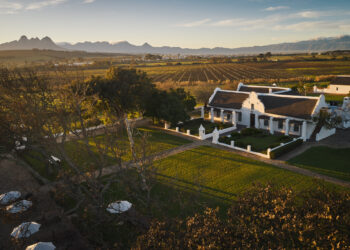
At Delheim Estate in Stellenbosch, the Sperling family’s commitment to wine excellence is deeply intertwined with the history of Pinotage. From its distinctive Simonsberg terroir to the pioneering role it played in Pinotage production, Delheim has long been a torchbearer for South Africa’s signature red grape.
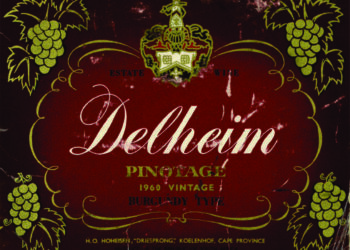
Delheim’s first commercially produced Pinotage, dating back to 1960, is considered one of the earliest estate-produced Pinotages in the country. While the first recorded Pinotage in South Africa was bottled under the Lanzerac label in 1959, Delheim’s early efforts were a defining moment for estate-level winemaking in this varietal. “My father, Spatz, arrived at Delheim from Germany in 1951, and in his memoir, he speaks about the farm experimenting with Pinotage as early as the 1950s,” says Victor Sperling, Delheim’s Director. “Pinotage was always part of the Delheim narrative.”
Spatz Sperling’s memoir is filled with stories about Pinotage, including a humorous mishap in 1966 when a tank collapsed, sending gallons of Pinotage streaming down the mountain. Another memorable moment was in 1965 when Spatz proposed to Vera Reinarz in the Delheim garden, accompanied by a glass of his Pinotage.
In the early days, Delheim’s Pinotage bottles carried the label “Burgundy type,” reflecting the estate’s intention to capture the refined elegance of the variety. According to Delheim cellarmaster Roelof Lotriet, “Tasting Delheim Pinotages from the 1970s and 1980s reveals a consistent approach of gentle, less-is-more winemaking.” Lotriet notes that Pinotage, which only started being planted for winemaking in the 1940s and 1950s, was still relatively new to winemakers in the 1960s. Its distinct traits, such as early ripening and quick fermentation, required a nuanced approach that Spatz Sperling intuitively understood.
Today, Delheim’s flagship Pinotage is the Vera Cruz Pinotage, made from a vineyard planted in 1996 on oakleaf soils with a significant clay component. “Vera Cruz is our flagship because it comes from our best Pinotage vineyard,” says Lotriet. Set on a south-west facing slope 240 meters above sea level, the vineyard benefits from ideal sunlight and cooling summer breezes from the southeast.
The winemaking process for Vera Cruz Pinotage starts with meticulous grape selection in the vineyard, ensuring only the highest quality fruit makes it to the cellar. After de-stemming, the grapes are placed in open-top fermenters where natural fermentation begins, followed by inoculation with a selected yeast strain. “Pinotage ferments quickly and can generate heat, so we keep the temperature at a mild 26°C, using gentle punch-downs and pump-overs to ensure soft tannin extraction,” explains Lotriet. The wine is then aged for 18 months in a mix of 300L and 500L French oak barrels, 35% of which are new, to allow for balanced oak influence without overwhelming the wine.
Delheim also produces a Family Premium Pinotage, made from three vineyards at a slightly lower altitude than Vera Cruz. The grapes are vinified separately and aged for 18 months in older French oak barrels before blending.
Lotriet has observed a growing appreciation for Pinotage in recent years. “Winemakers now understand that treating Pinotage like Cabernet Sauvignon or Shiraz leads to overdone wines,” he says. “At Delheim, our ideal growing sites and a legacy of respecting the grape in the cellar allow us to offer a refined expression of Pinotage—South Africa’s home-grown red grape and a part of Delheim’s heritage.”